
Growth is often seen as a sign of success.
A business opens a new branch, acquires another company, expands into new markets or launches new business units. Each milestone represents progress, creating new opportunities for revenue and long-term value.
However, growth also introduces a challenge that many organisations underestimate: maintaining a clear view of financial performance across the entire business.
As organisations become more complex, so does financial reporting. What was once a straightforward budgeting process can quickly evolve into managing multiple entities, different reporting structures, varying currencies and separate financial systems.

The question for leadership is no longer simply "Are we growing?" but "Can we clearly see how every part of the business is performing?"
📉When Complexity Begins to Outpace Visibility
As businesses expand, finance teams often find themselves responsible for multiple profit and loss statements, balance sheets, cashflow forecasts and budgets, each representing a different entity or business unit.
For organisations operating internationally, the challenge extends even further. Exchange rate fluctuations, regional performance and local reporting requirements all need to be reflected accurately while still providing a consolidated picture of the business.
Many organisations initially manage this complexity with spreadsheets. While effective in the early stages, manual consolidation becomes increasingly difficult as the number of entities grows.
Currency conversions must be maintained. Intercompany transactions need to be reconciled. Reporting structures require alignment. Each individual forecast may be accurate, but bringing everything together into a single, reliable view becomes an increasingly time-consuming exercise.
🏗️ Building a Complete Financial Picture
For many finance teams, the solution lies in moving beyond disconnected reporting and adopting tools that consolidate information while preserving visibility into each part of the organisation.
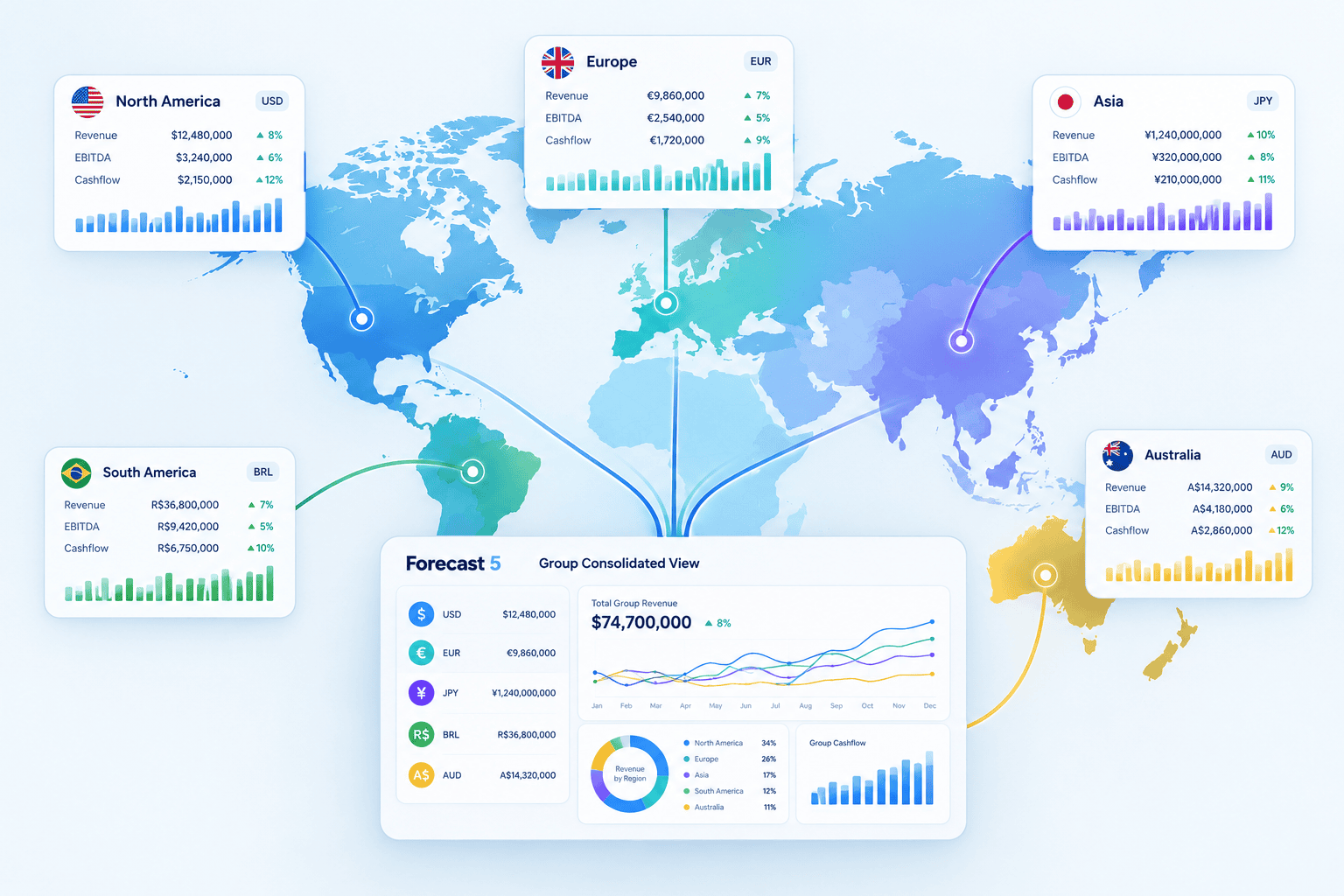
Forecast 5 enables businesses to combine multiple entities into a single consolidated financial forecast while maintaining detailed reporting for individual companies, branches or business units.
The Multi-Currency functionality also allows organisations to forecast in local currencies and view the combined impact across the wider group, helping finance teams understand both regional performance and overall financial position.
💡 Better Information Supports Better Decisions.
Consolidated reporting provides more than a single set of numbers. It gives leadership the context needed to understand how the organisation is performing as a whole.
With greater visibility, decision-makers can identify which business units are driving growth, where costs are increasing, how individual entities contribute to group performance and how currency movements are influencing financial results.
Perhaps most importantly, they can assess how decisions made in one part of the organisation may affect the wider business.
📊 Growth Demands Better Visibility.
Growth inevitably brings greater complexity. As organisations expand, maintaining accurate, timely and meaningful financial reporting becomes increasingly important.
Consolidation tools that bring together multiple entities, currencies and reporting structures help finance teams provide leadership with a clearer picture of business performance.
Because while understanding each business unit is important, understanding how they work together is what enables organisations to manage growth with confidence.

Faster Forecasts.
Fewer Errors.
One Trusted Platform.
Take The Next Step!
Start your free trial or request a demo to experience smarter forecasting